
Invoice Dockets Workflow
As a subcontractor administrator, you can use Virtual Superintendent with your accounting software to invoice approved dockets.
Note: Docket states are important when invoicing. Dockets with an Approved state are typically ready to invoice. To learn about docket states, read the Work With Electronic Dockets help article.
In this article
- Permissions
- Invoicing tasks overview
- Step 1: Filter approved dockets
- Step 2: Generate trial CSV export
- Step 3: Create an invoice in your accounting software
- Step 4: Apply the invoice numbers to the dockets
- Step 5: Generate the final detailed CSV export
- Step 6: Send the invoice to the head contractor
- Video guide
Permissions
To access the Dockets page (Menu > Dockets) and filter for Approved dockets, create CSV export files, apply external invoice numbers to dockets, and send invoices, you must have the following permission:
- Subcontractor Admin
Invoicing Tasks Overview
The invoicing process consists of the following tasks:
- Filter for approved dockets in Virtual Superintendent.
- Generate a trial Detailed CSV export file.
- Create an invoice in your accounting software.
- Apply the invoice number to the dockets in Virtual Superintendent.
- Generate a final Detailed CSV export file.
- Email the invoice and the final CSV export file to the head contractor.
Step 1: Filter Approved Dockets
Your first step should be filtering the Dockets page to display the dockets that are ready to invoice. These are typically dockets that have been given a status of Approved by an engineer.
To filter the Dockets page to show Approved dockets:
- Sign in to Virtual Superintendent.
- Click Menu > Dockets. The Dockets page opens.
-
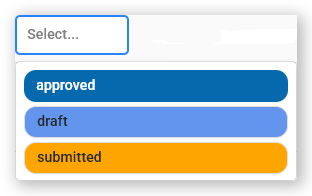
Click the filter at the top of the State column.
 Click or tap to expand image
 - Select Approved. Only dockets with an Approved state appear.
Step 2: Generate Trial CSV Exports
Next, generate a Detailed CSV containing the approved docket details. Use this file as a reference when you create the invoice in your own organization's accounting software.
To generate a CSV export file:
- Select the checkboxes beside all dockets that you want to invoice.
-
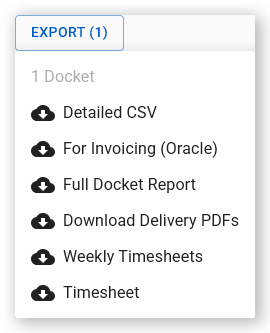
Click Export. A contextual menu opens.
 Click or tap to expand image
 - Select Detailed CSV. Virtual Superintendent downloads the Detailed CSV file to your computer. The file contains the details of the selected approved dockets.
Note: Select Detailed CSV, not For Invoicing (Oracle). For Invoicing (Oracle) is a legacy option used by a limited number of customers.
Step 3: Create an Invoice In Your Accounting Software
Note: This step is completed outside Virtual Superintendent.
Use the Detailed CSV file created in step two as a reference to create an invoice for the selected dockets in your organization's accounting software (not in Virtual Superintendent).
After you create the invoice, note the invoice number that your accounting software creates. You need this number to update the corresponding dockets in Virtual Superintendent.
Step 4: Apply the Invoice Numbers to the Dockets
Next, apply the invoice number from your accounting software to the corresponding docket in Virtual Superintendent.
To apply the invoice number in Virtual Superintendent:
- Sign in to Virtual Superintendent.
- Click Menu > Dockets. The Dockets page opens.
-
Click the filter at the top of the State column.
Click or tap to expand image - Select Approved. Only dockets with an Approved state appear.
- Select the checkboxes beside all dockets to be included in the invoice.
-
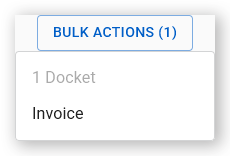
Click Bulk Actions. A contextual menu opens.
 Click or tap to expand image
 -
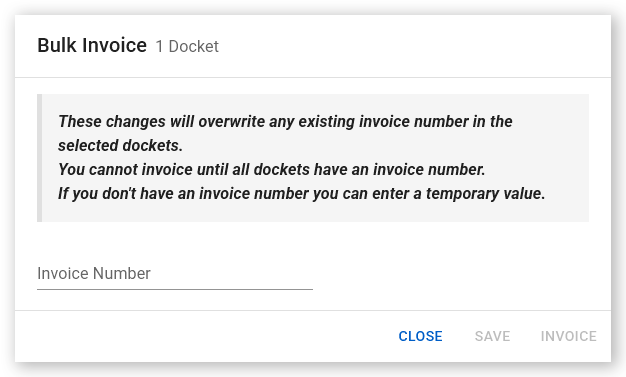
Select Invoice. The Bulk Invoice dialog opens.
 Click or tap to expand image
 - Enter the invoice number from the external accounting software in the Invoice Number field. The Invoice and Save buttons activate. If any of the dockets selected in step five are in a state other than Approved, only the Save button activates and the Invoice button remains disabled.
- Click Invoice then Invoice again to confirm. If the dockets already have an invoice number, this action will overwrite the number with your new invoice number. The status of the selected dockets updates to Invoiced.
- The invoice number appears in the Invoice Number column for the selected dockets.
The head contractor can also see the invoice number on their Dockets page. This helps the head contractor and subcontractor identify which dockets belong to each.
Note: You can't invoice dockets until they all have an invoice number. If you don't yet have an invoice number, you can use a temporary placeholder value and click Save to update the dockets without invoicing and then repeat and finish this process when you have these details.
Step 5: Generate the Final Detailed CSV Export
After you apply the invoice number, generate a final Detailed CSV to send to the head contractor with the invoice.
To generate the final detailed CSV export file:
- Filter the State column by Approved and the Invoice Number column by the applicable invoice number. The dockets that are ready to be invoiced are shown.
- Select the checkboxes beside all dockets to be invoiced.
-
Click Export. A contextual menu opens.
Click or tap to expand image - Select Detailed CSV. The final Detailed CSV includes the invoice number applied to the dockets.
Note: Select Detailed CSV, not For Invoicing (Oracle). For Invoicing (Oracle) is a legacy option used by a limited number of customers.
Step 6: Send the Invoice to the Head Contractor
Finally, send the following files to the head contractor:
- The invoice generated in your accounting software.
- The final Detailed CSV exported from Virtual Superintendent.
The invoice number in the Detailed CSV allows the head contractor to match the invoiced work to the corresponding dockets.
Video Guide
Watch the following video guide to learn more about processing invoices: