
Bulk Import Plant Equipment Using an Excel Spreadsheet
Head contractors can use the Excel import feature in Virtual Superintendent to onboard or update plant equipment in bulk.
This feature allows you to download a template, populate or edit plant information, and import it to quickly manage large numbers of assets.
Note: To manually onboard, edit, or offboard plant equipment, refer to the On-board and Manage Plant Equipment help article.
Permissions
To access the Plant page (Menu > Plant) and import machinery files, you must have one of the following permissions:
- Admin Manager
- User Admin
Download the Plant Excel Template
Before importing plant equipment, you must download the Excel template.
To download the template:
- Sign in to Virtual Superintendent.
- Click Menu > Plant. The Plant page opens.
-
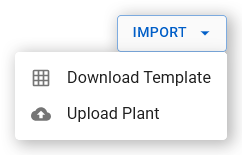
Click Import. A contextual menu opens.
 Click or tap to expand image
 -
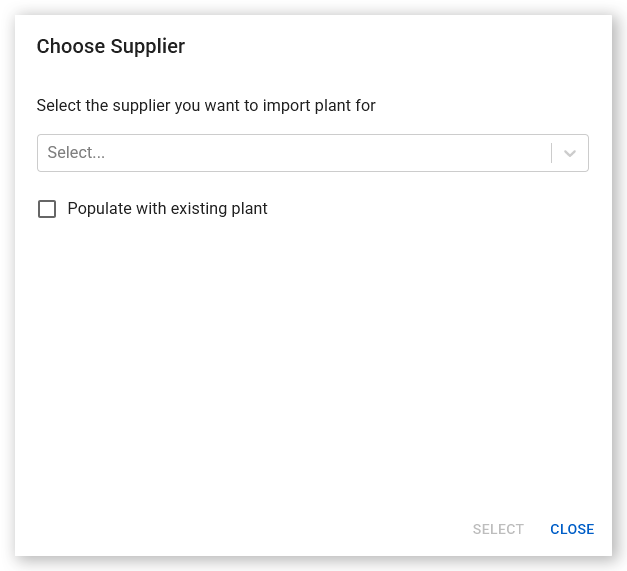
Select Download Template. The Choose Supplier dialog opens.
 Click or tap to expand image
 - Select a Supplier from the dropdown.
- Choose whether the populate the template. Select Populate with existing plant to include all existing plant equipment in the template file, allowing you to edit them in bulk. Leave the box empty to download a blank file and add only new plant.
- Click Select. The template downloads to your computer in .xlsx format using the file name format
vs_Plant Import Template [Selected Supplier Name]_YYMMDD-HHMMSS. - Open the downloaded file and enter the details of each plant item (see the tables below for required and optional fields). Each row represents a single piece of plant equipment. Once complete, save the file and import it using the Upload Plant option.
Required Fields
The following fields must be completed for each plant item:
| Field | Description | Validation Rules |
| Role | Role of the onboarded plant |
Required; must match an existing role; select a valid role from the dropdown
|
| Plant ID/ Rego No | Unique identifier for the plant or registration number |
Required; alpha-numeric; must be globally unique
|
| Model | Model of the plant | Required; alpha-numeric |
Optional Fields
The following fields can be used to provide additional cost code information:
| Field | Description | Validation Rules |
| Secondary Plant ID / Rego No |
Unique secondary identifier for the plant or registration number
|
Alpha-numeric; must be globally unique |
| Trailer ID / Rego No | Trailer ID or registration number | Alpha-numeric |
| EPA Certification Number | EPA certification number | Alpha-numeric |
| Comments | Relevant comments about the machine | Alpha-numeric |
| SMU Start | The first SMU reading manually recorded for the machine | Alpha-numeric |
| Tare Weight | Weight of the machine when empty. Also known as the curb weight | Number; minimum of 1000 if used |
| Gross Vehicle Mass (GVM) | Maximum weight of the machine, in kilograms, when fully loaded. Typically determined by the manufacturer | Number; minimum of 1000 if used |
| General Mass Limits (GML) | Maximum allowable loaded weight, in kilograms, for the machine when on road | Number; minimum of 1000 if used |
| SPECTS Weight | Safety, Productivity and Environment Construction Transport Scheme weight in kilograms | Number; minimum of 1000 if used |
| Performance Based Std. Weight (PBS) | Allowable weight for the machine in kilograms if using the PBS scheme | Number; minimum of 1000 if used |
| Number of Axles | Number of vehicle axles | Number; integer (no decimals); defaults to 4 |
| Approximate Payload | The approximate payload for the machine when an exact weight is unavailable using either a weighbridge or Virtual Weighbridge input | Number; integer (no decimals) |
| Payload Unit | UOM for the approximate payload | Unit of measure; select kg or m3 from the dropdown |
| Speed Limit (km/h) | Speed limit for the machine in km/h. | Number; integer (no decimals) |
| Item Code | Item being billed | Must match an existing item; select a valid item from the dropdown |
| Internal Machine Running Cost ($/hr) | Internal cost of running the machine in dollars per hour | Number |
| Dry Hire | Specify whether the equipment is provided with or without operators | Yes or No |
| Fuel Consumption Under Load (L/hr) | Liters of fuel used by the machine every hour when under mechanical load | Number; integer (no decimals) |
| Fuel Consumption While Empty (L/hr) | Liters of fuel used by the machine every hour when not carrying a load | Number; integer (no decimals) |
| Fuel Consumption While Idle (L/hr) | Liters of fuel used by the machine every hour when idling (engine running but vehicle not in motion) | Number; integer (no decimals) |
| Expected Operating Hours (per day) | Number of hours that you expect the machine to be operating each day | Number |
| Minimum Chargeable Hours | The minimum number of hours that each machine should be in operation daily, weekly or monthly | Number |
| Chargeable Hours Unit | The unit used for the minimum chargeable hours value | Daily, weekly, or monthly; select a unit from the dropdown |
| Digital Matter Serial No. | Serial number if a Digital Matter device is installed on the machine | Number |
Note: In the template:
- Required columns are highlighted in blue with column titles appended with (Req)
- Optional columns are highlighted in green
Caution: Only edit existing (prepopulated) Plant ID / Rego No or Secondary Plant ID / Rego No when both fields already contain values. Editing a machine that has only one of these values (for example, editing the Secondary Plant ID / Rego No of a machine with no Plant ID /Rego No) will create a duplicate item.
When adding new plant equipment, the values in the Plant ID / Rego No and Secondary Plant ID / Rego No fields must be globally unique and unique from one another.
For best results, we recommend that you:
- Download the Excel template each time you begin the import process. Virtual Superintendent may update the template at any time, and using the latest version helps prevent errors.
- Use dropdown lists where available.
- Copy and paste data carefully to avoid formatting issues.
- Check that all Plant ID / Rego No and Secondary Plant ID / Rego No values are used only once across all plant equipment.
- Start with a small test upload before importing large datasets.
- Save the template regularly to avoid losing changes.
Tip: If you are importing many pieces of plant equipment, consider splitting the file into smaller batches to make troubleshooting easier if errors occur.
Import an Edited Excel Template
- Sign in to Virtual Superintendent.
- Click Menu > Plant. The Plant page opens.
-
Click Import. A contextual menu opens.
Click or tap to expand image -
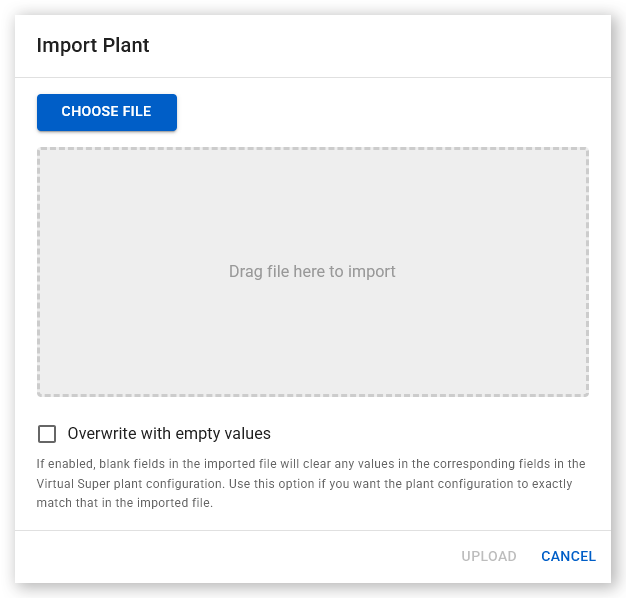
Select Upload Plant. The Import Plant dialog opens.
 Click or tap to expand image
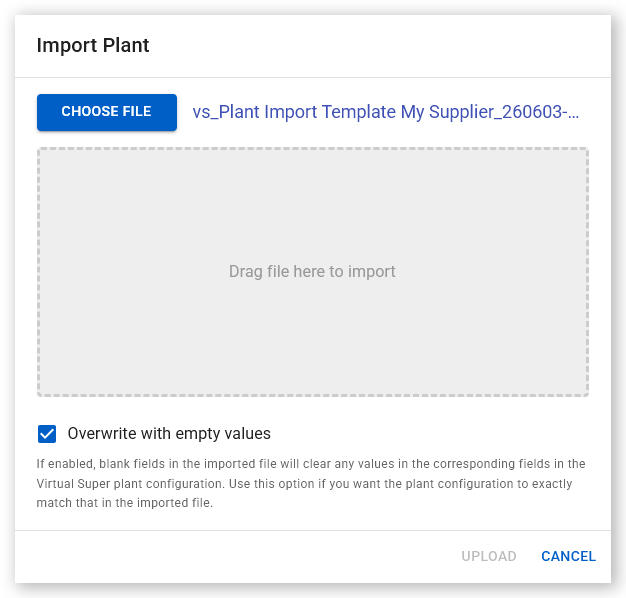
 - Click Choose File to open your file explorer, select the import file, and click Open. Alternatively, drag and drop the import file into the Drag file here to import area. Your import file must be in .xlsx format.
-
Select the Overwrite with empty values checkbox if you want any empty fields in the import file to overwrite any existing values in Virtual Superintendent, including any populated fields. Use this option if you want the plant values in Virtual Superintendent for the plant being imported to match exactly with the values in the import file. Leave the box empty to import only new fields or edited fields containing data See the note below for additional information.
 Click or tap to expand image
 -
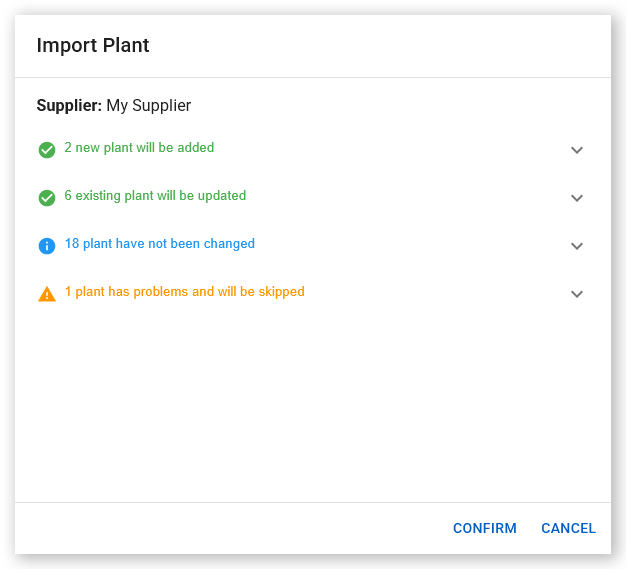
Click Upload. Virtual Superintendent uploads and validates the file. A preview showing the number of plant items that will be added or updated is displayed, along with the number of existing plant items that will not be changed. If any rows fail validation, an orange text alert shows the number of plant items that will be skipped (not imported). Click the downward arrow to view each error, including the issue and the affected row. Correct the errors in your file and try again.
 Click or tap to expand image
 -
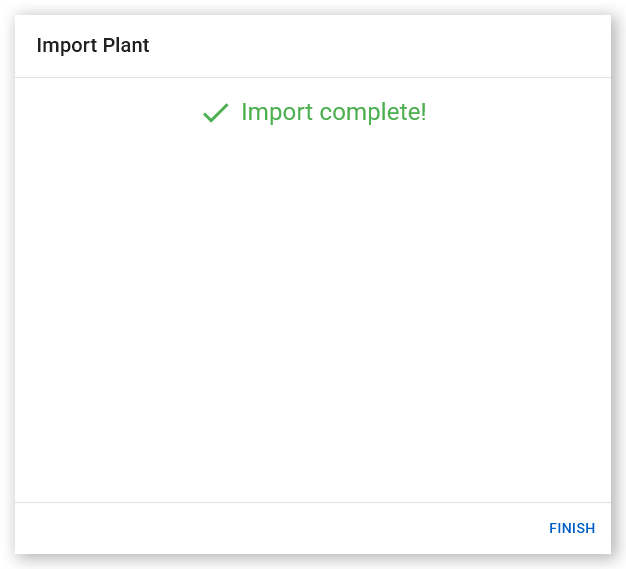
Click Confirm to proceed. New plant items are created, and existing plant items are updated for all valid rows. The results are displayed in the Plant list.
 Click or tap to expand image
 - Click Finish to complete the process.
Note: Use the Overwrite with empty values option to delete existing field entries. If this option is selected, any empty fields in your template overwrite their corresponding values in Virtual Superintendent, removing them. For example, removing values from the Speed Limit column will clear the speed limit for those machines. See this video for more information.