
Install a LoadRite L2180 Connector Box
You can connect a LoadRite L2180 load scale device to the SafeSite mobile app using a Virtual Superintendent LoadRite cable connector box. This connection allows weight data collected via the CAN bus (Controller Area Network) to automatically populate Virtual Weighbridge (VWB) dockets.
This article explains how to install the LoadRite cable connector box between a LoadRite L2180 device and a mobile phone, and how to use it to share data with SafeSite.
In this article
What You Need
To complete the installation, you need:
- LoadRite L2180 device (preinstalled on the machine, not supplied)
- LoadRite wire harness to expose CAN bus wires (connected to the L2180, not supplied)
- Virtual Superintendent LoadRite cable connector box
- A mobile phone running the SafeSite app
Before You Begin
Before installing the cable connector box and the SafeSite mobile phone, ensure the LoadRite L2180 device is already installed on the machine and connected to the optional CAN bus wire harness (available from LoadRite).
The CAN bus harness exposes the machine’s CAN bus to external devices. In this setup, it allows data to be shared with the Virtual Superintendent LoadRite cable connector box.
Once installed and connected, this data enables loader operators to create Virtual Weighbridge (VWB) dockets automatically.
The LoadRite Cable Connector Box
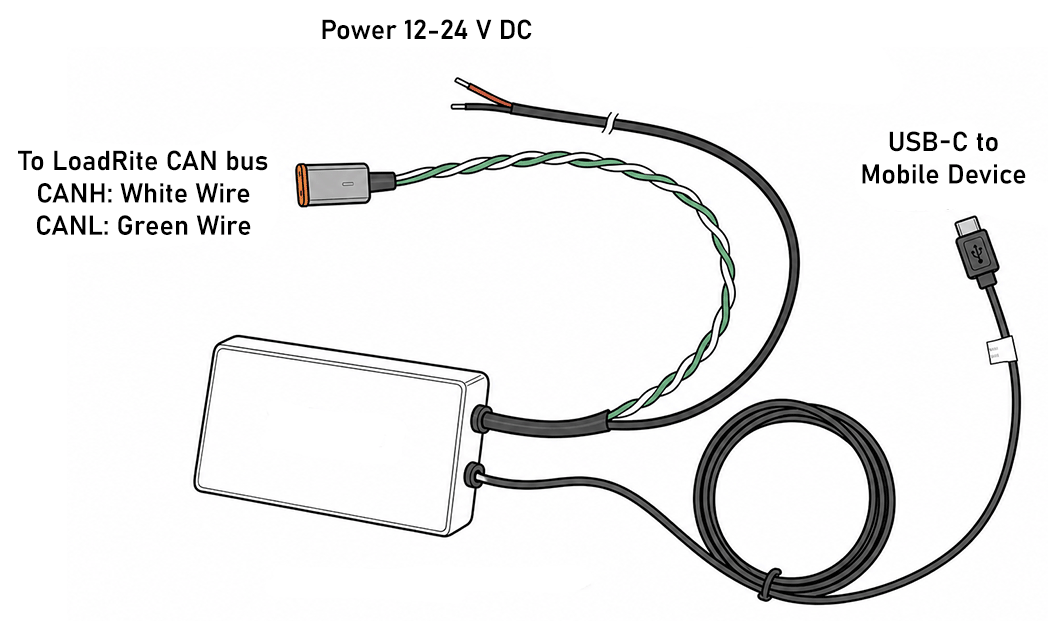
The Virtual Superintendent LoadRite cable connector box includes three connections:
- USB‑C - Connects to a mobile phone running the SafeSite app.
- Power - Connects to a 12–24 V DC permanent power source on the machine using the red and black wires.
- CAN bus - Connects to the LoadRite L2180 CAN bus harness using white and green wires, or white and white/yellow-striped wires.
Install the Cable Connector Box
To install the Virtual Superintendent LoadRite cable connector box:
- Check that the LoadRite CAN bus wire harness is connected to the LoadRite L2180 device. If not yet connected, connect this first. Contact LoadRite for wiring details.
- Enable the CAN bus security code on the LoadRite L2180. Contact LoadRite to obtain the required code.
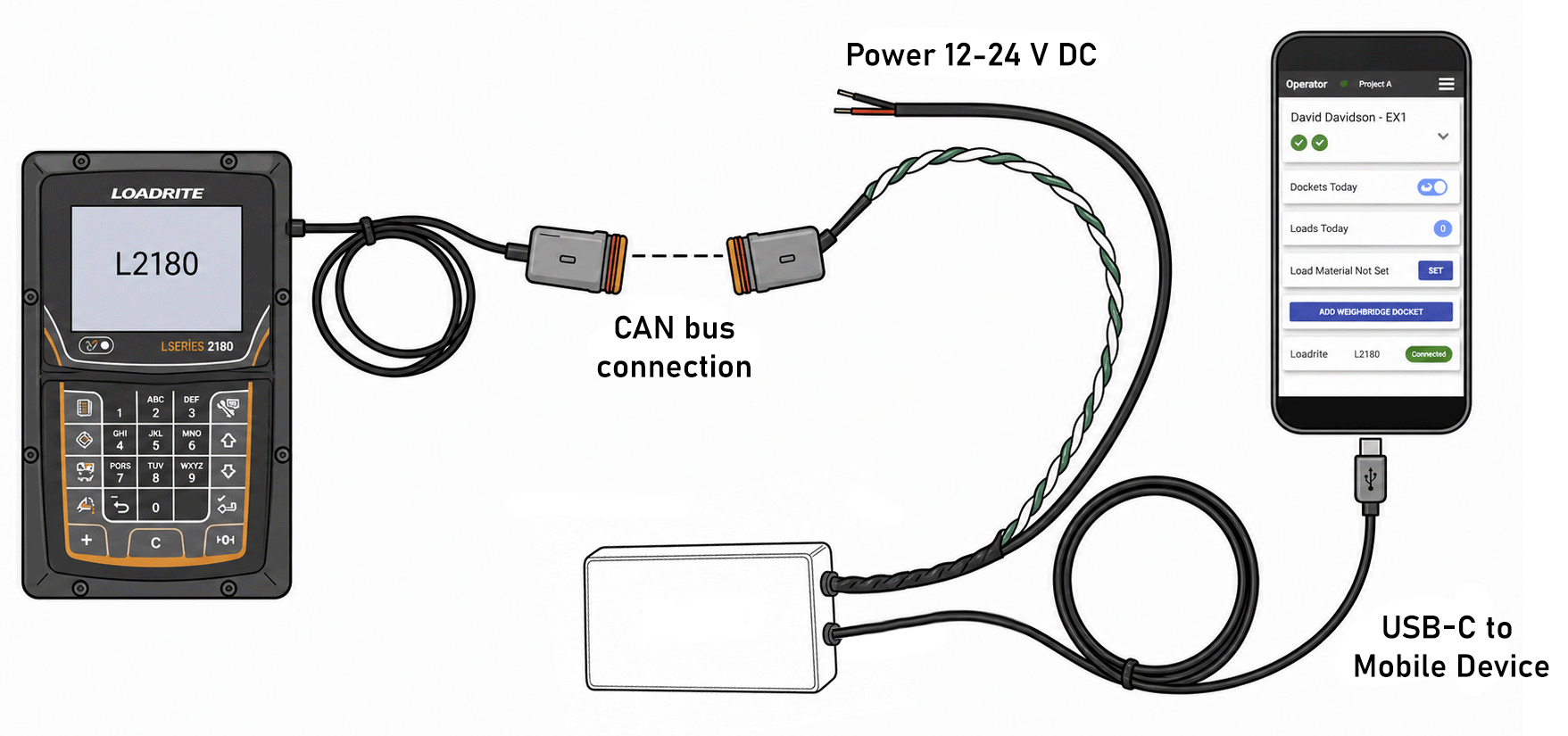
- Connect the Virtual Superintendent LoadRite cable connector box's power cable (red and black wires) to a 12–24 V DC power supply in the machine. This powers and charges the SafeSite phone.
- Connect the cable connector box CAN bus harness plug to the LoadRite L2180 CAN bus harness.
- Plug the USB‑C plug from the LoadRite cable connector box into the SafeSite phone. Make sure the phone is on. When prompted, check the box beside Always open SafeSite when USB serial is connected, then tap OK.
- Sign in to the SafeSite app and check the connection status.
After signing in:
- A green Connected icon indicates the installation is complete and ready to record VWB dockets.
- A red Error icon indicates a connection issue.

If an error occurs, unplug the phone and try again.
Error Messages and Troubleshooting
A LoadRite error message usually indicates one of the following:
- The phone is not securely connected to the USB‑C cable
- The phone does not support the required USB‑C specifications
- The USB cable is faulty
Phone compatibility
Some mobile devices might not be compatible with the LoadRite L2180 device or the Virtual Superintendent LoadRite cable connector box.
- Later‑model Samsung phones with USB‑C 2.0 OTG or higher are supported.
- Some lower‑end Oppo phones are not supported.
To check your phone's USB‑C specifications, visit www.gsmarena.com.
If the error persists after checking connections and phone specifications, contact Virtual Superintendent support.
Important Configuration Information
Before the SafeSite app can communicate with a LoadRite system, the device must be configured to support this integration.
Contact Virtual Superintendent support to confirm that any SafeSite device you connect to a LoadRite system is configured correctly.